How to Choose the Right Storage Rack for Your Supermarket or Retail Store
Picture two grocery stores of the same size, selling the same products. One feels cramped and cluttered, with staff struggling to restock shelves during rush hour. The other feels open, organized, and easy to shop in, even during peak crowds. Nine times out of ten, the difference isn’t the products — it’s the racking.
Choosing a supermarket storage rack is a decision retailers tend to rush through, treating it as a minor logistical task rather than a strategic one. But racking touches nearly every part of daily operations: how fast your team can stock shelves, how much inventory you can physically hold, how the store looks to a first-time visitor, and whether your staff and customers stay safe while moving around. An unsuitable rack setup doesn’t correct itself over time — it keeps draining staff hours and wasting floor area for as long as it remains in use.
At Sahay Racks, we spend our time thinking about exactly this problem, working with grocery and retail businesses of every size to get their shelving right the first time. This article walks through the framework we use with clients at Sahay Racks, broken down so you can apply it directly to your own store.
The Real Cost of Getting Racking Wrong
Retail runs on thin margins, and every unused inch of floor space is money left on the table. When racking decisions are made carelessly, the fallout usually shows up as:
- Dead corners and awkward gaps that can’t hold usable inventory
- Customers unable to spot products quickly, which slows down billing and drags out queue times
- Items shifting, sagging, or falling because a shelf was never meant to carry that load
- A rack system that looks tired and mismatched within a year or two
- Rising repair and replacement costs that eat into what you saved by buying cheap
Every one of these problems is avoidable — they show up specifically when planning gets skipped. None of this needs to happen, though — sidestepping it just takes a bit of upfront planning.
What to Evaluate Before Buying Supermarket Racks
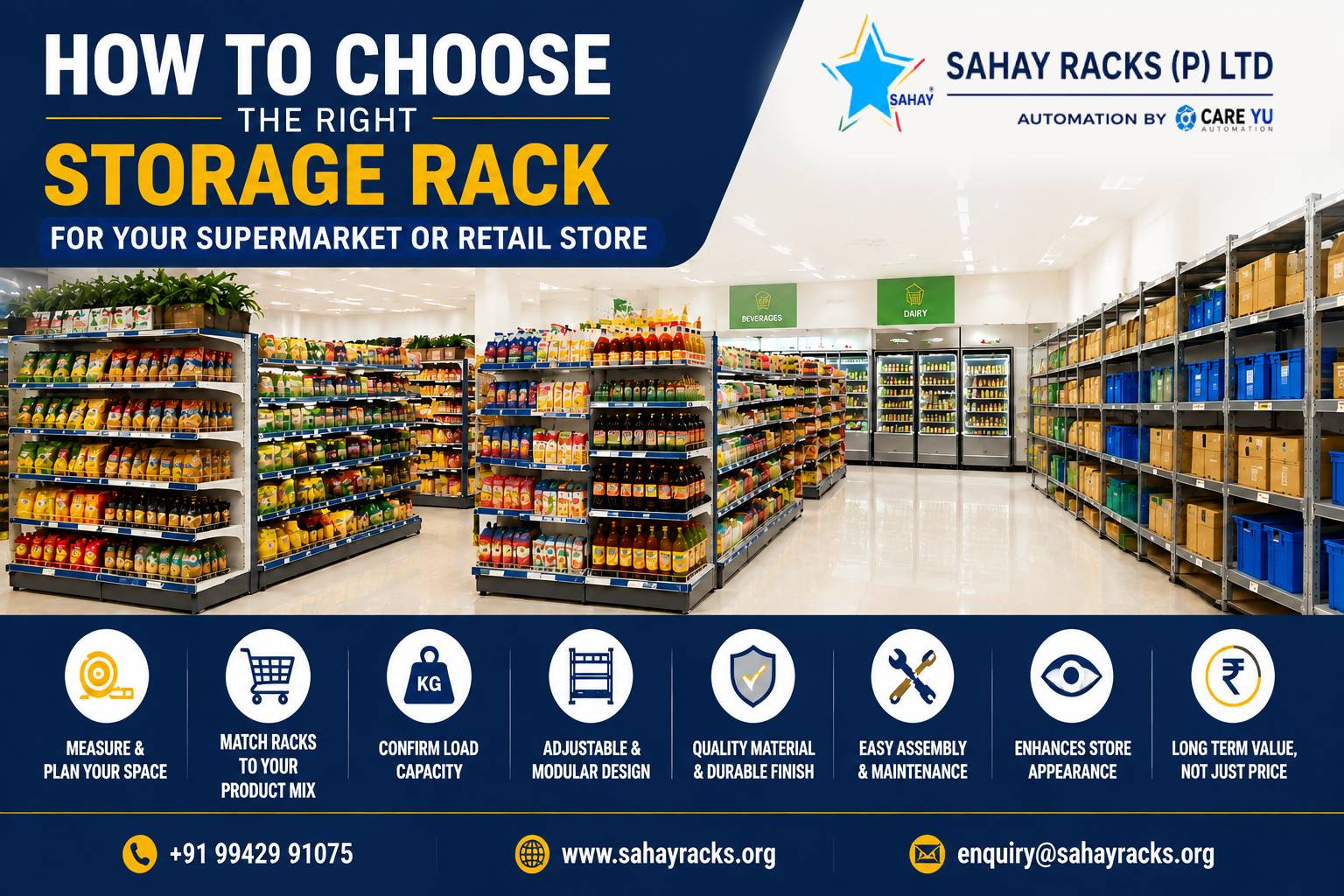
1. Start With a Proper Floor Survey
Before you even browse a rack catalog, walk your store with a measuring tape. Record your walkway widths, ceiling height, door and entry clearances, and where your billing counter sits relative to the rest of the layout. A figure often used as a rule of thumb in store design is roughly 3 to 3.5 feet of clear walkway — enough room for two people carrying baskets or pushing trolleys to pass one another without squeezing by, while still leaving most of the floor available for shelving.
Armed with accurate measurements, you can then decide how to split your store between:
- Perimeter wall shelving for display along the store’s outer walls
- Central island or gondola units, often double-sided to serve two aisles at once
- Corner-fit racks that turn otherwise wasted corners into usable display space
2. Let Your Product Mix Drive the Rack Choice
It’s easy to default to one rack style for the entire store, but different product categories genuinely need different shelving. Canned goods and produce, for instance, have almost nothing in common when it comes to how they should be stored and displayed.
A few examples of how store sections typically map to rack types:
- General grocery and FMCG aisles usually work best with gondola-style racking, since it’s double-sided, flexible, and can hold a wide variety of packaging sizes.
- Space-constrained stores benefit from slim, single-sided gondola units along narrow aisles — they take up less floor depth than double-sided racks while still keeping products fully visible.
- Backroom and stockroom areas are better served by slotted angle units, which are quick to reconfigure whenever inventory volumes shift.
- Bakery items and fresh produce need ventilated storage, so wire or mesh-frame shelving works better than solid metal panels that trap humidity.
- Bulk stock headed for the godown, like sacks or large cartons, calls for heavy-duty pallet racking rather than sales-floor display units.
- Small impulse-buy items near the checkout counter do well on compact, purpose-built checkout racks designed for quick grab-and-go purchases.
The principle to hold onto: map your product categories first, then shop for racks — not the reverse.
3. Confirm Weight Capacity in Writing
Every rack has an upper limit on how much weight it can safely hold per shelf and per bay, and pushing past that limit isn’t a minor inconvenience — it’s a genuine safety concern for anyone near it. Dense, heavy items such as rice sacks, cooking oil cans, and bottled beverages demand reinforced shelving and stronger vertical supports, while lighter categories like packaged snacks or cosmetics can sit comfortably on standard-duty racks.
Rather than relying on a verbal assurance from your supplier, ask for the load rating documented in writing for both individual shelves and full bays, and plan your stock with some margin below that number instead of loading right up to the edge.
4. Look for Adjustable, Modular Design
Inventory in a retail store rarely stays static — new SKUs get added, packaging sizes change, and seasonal stock comes and goes. A rack system with fixed shelf positions locks you into one layout indefinitely, which becomes a real limitation within a year or two. Favor racks that offer:
- Shelves that move up or down along adjustable slots
- Add-on components that let you expand a bay without buying a whole new unit
- A design that can be reconfigured without needing specialized tools
Because of this, you can reshuffle your layout for a seasonal sale or a newly added product category without dismantling and replacing what you already have.
5. Inspect Material and Build Quality
Supermarket shelving is commonly built using cold-rolled or mild steel, which is then powder-coated to prevent rust from setting in.When comparing options side by side, look closely at:
- Whether the powder coating is even, or patchy in places
- How clean and solid the welds look at joints and corners
- Whether the finish is treated to resist rust, which matters more in humid climates
- How much a shelf flexes when you press down on it with moderate pressure
Two racks can look nearly identical in a showroom, yet one might use noticeably thinner steel that starts sagging or corroding within a couple of years of daily use.
6. Think About Setup Time and Long-Term Maintenance
Retail stores can’t afford to shut down for days while racks are being installed or rearranged. Bolted or slot-and-lock rack designs are typically quicker to assemble than fully welded ones, and if a single shelf or bracket gets damaged later, you can usually swap out that one part instead of replacing the entire unit.
7. Don’t Overlook the Visual Impact
Shelving isn’t purely functional — it shapes how customers experience your store the moment they walk in. Straight lines, consistent shelf spacing, clear sightlines to products, and a coordinated color scheme all contribute to a store that feels well-run and trustworthy. Many supermarkets now pick rack finishes that either stay neutral or match their brand palette, tying the whole floor together visually.
8. Weigh Upfront Price Against Total Value
Going with the cheapest quote is tempting, but racking is a long-term asset, not a disposable purchase. A rack priced 20% higher that lasts three times as long, holds more weight safely, and needs less upkeep will almost always work out cheaper over its lifetime. Before deciding on price alone, ask suppliers directly about warranty terms, expected service life, and what after-sales support actually looks like.
Quick Pre-Purchase Checklist
- ☐ Store layout and walkway widths measured
- ☐ Product categories mapped to appropriate rack types
- ☐ Load ratings confirmed in writing, per shelf and per bay
- ☐ Shelf adjustability and modularity verified
- ☐ Material and finish quality inspected
- ☐ Assembly method and repair ease compared
- ☐ Visual fit with store branding considered
- ☐ Total lifetime cost weighed, not just the purchase price
Bringing It All Together
A supermarket’s racking system rarely gets the spotlight, but it quietly shapes nearly every part of how the store runs day to day. Working through your floor layout, matching rack types to your actual product mix, verifying load capacity, and choosing quality construction over the lowest quote will save you far more in efficiency and durability than it costs upfront.
Ready to Set Up or Upgrade Your Racking?
Sahay Racks designs and supplies gondola units, wall racks, slotted angle systems, and pallet racking built to hold up under daily retail use. Our team can walk your floor plan with you and recommend a layout suited to your actual space and product mix, so the setup works correctly from day one rather than needing fixes later.
Reach out to Sahay Racks for a free consultation and a quote built around your store’s specific needs.
Call to Action
👉 Need a warehouse storage solution?
Contact Sahay Racks today for a free consultation and layout design.
 Call us today +91 9942991075
 Visit: www.sahayracks.org
 Request a free consultation and stay connected with us for updates and insights on Facebook and LinkedIn.