Pallet Racking System vs Heavy-Duty Shelving: Choosing the Right Warehouse Storage Solution
Choosing the right storage solution is essential for maintaining an organized, efficient, and productive warehouse. Two popular options are Pallet Racking System and heavy-duty shelving. While both are designed to maximize storage capacity, they serve different purposes depending on the type of inventory, load requirements, available space, and warehouse operations.
Understanding the difference between pallet racking and heavy-duty shelving can help businesses select a storage system that improves accessibility, safety, and overall warehouse efficiency.
What Is a Pallet Racking System?
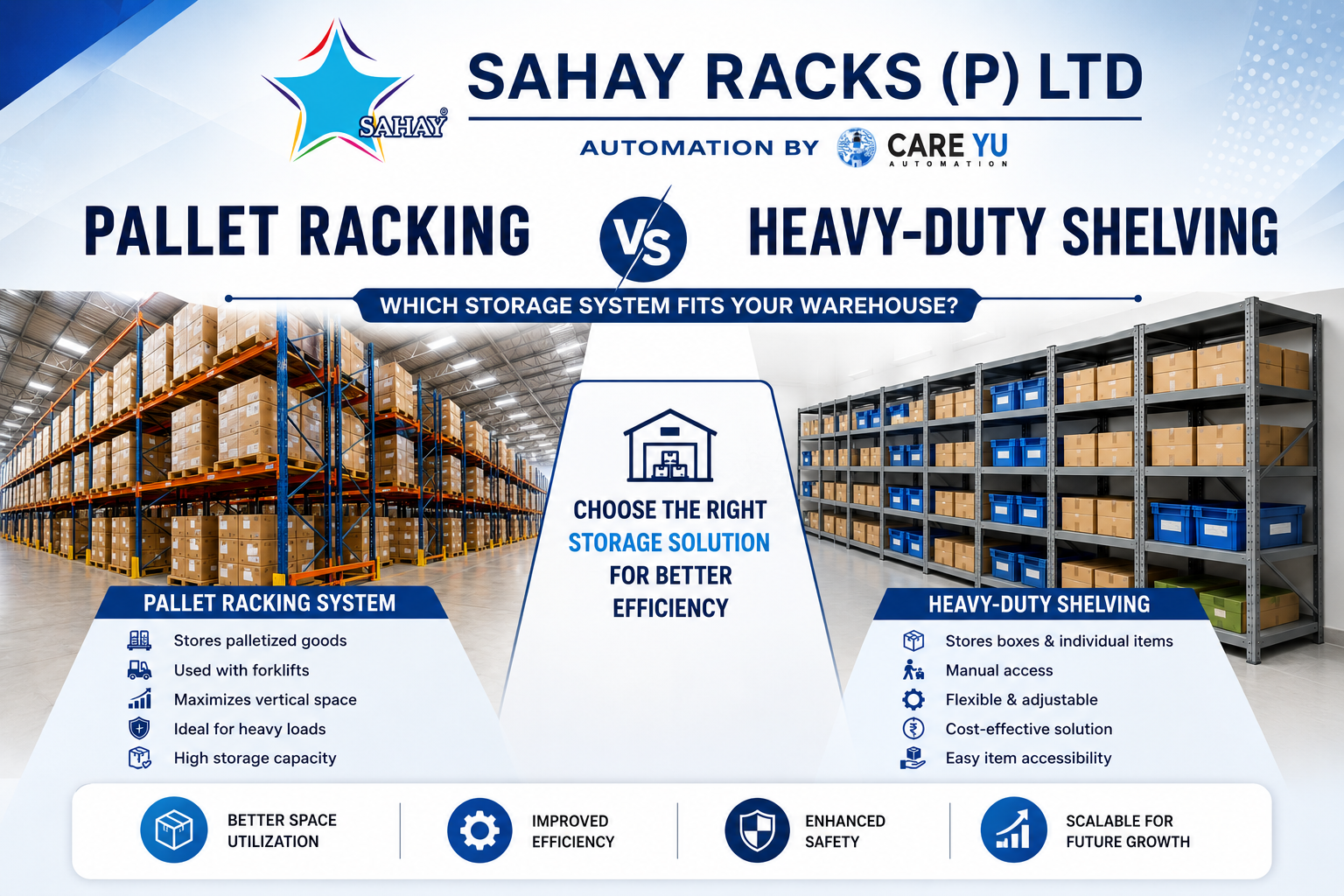
A Pallet Racking System is a robust warehouse storage system mainly intended for storing pallets. Vertical space is utilized effectively through creating storage tiers where warehouses can store. A pallet storage system enables warehouses to handle large stock capacities while effectively using the available floor space. It is commonly used in manufacturing plants, distribution centers, logistics facilities, and other facilities handling large inventories.
Businesses have the option of selecting different pallet racking systems depending on the needs of their warehouse, such as selective pallet racking and drive-in racking.
Key Benefits of Pallet Racking
- High-density storage capacity
- Excellent use of vertical warehouse space
- Suitable for heavy and bulky loads
- Easy access to palletized inventory
- Compatible with forklifts and material-handling equipment
- Flexible configuration and adjustable beam levels
- Suitable for large warehouses and distribution centers
What Is Heavy-Duty Shelving?
Heavy-duty shelving is designed for storing individual products, cartons, boxes, tools, components, and other items that may need to be manually accessed. Unlike pallet racking, shelving is generally designed around smaller inventory units rather than full pallets.
Heavy-duty shelves are useful for warehouses where products are frequently picked, sorted, counted, or handled manually.
They can be configured with multiple levels to make efficient use of available vertical space while keeping individual products easily accessible.
Key Benefits of Heavy-Duty Shelving
- Suitable for hand-loaded inventory
- Easy access to individual products
- Ideal for boxes, cartons, and components
- Flexible storage arrangements
- Suitable for medium- and heavy-load applications
- Helps organize frequently accessed inventory
Can be used in warehouses, workshops, stores, and stockrooms
Pallet Racking vs Heavy-Duty Shelving: Key Differences
Although both storage systems help organize warehouse inventory, their applications are different.
| Comparison Point | Pallet Storage Racks | Industrial Heavy-Load Shelves |
| Main Application | Best suited for storing goods on pallets | Designed for cartons, boxes, tools, and individual products |
| Loading Method | Generally handled using forklifts or pallet trucks | Usually loaded and picked manually |
| Storage Capacity | Ideal for high-volume warehouse inventory | Suitable for organized storage of smaller product quantities |
| Vertical Space | Makes excellent use of warehouse height | Provides multiple accessible storage levels |
| Product Access | Easy access to complete pallet loads | Convenient access to individual items |
| Ideal Warehouse | Suitable for distribution centers and large warehouses | Useful for stockrooms, workshops, and smaller storage areas |
| Best Choice For | Bulk and palletized materials | Frequently handled products and components |
When Should You Choose a Pallet Racking System?
A Pallet Racking System is a better choice when your warehouse stores large quantities of palletized products. It works well for warehouses that require several storage tiers, particularly when goods are loaded and retrieved with forklifts or other warehouse handling equipment.
Consider pallet racking if:
You Store Palletized Goods
If most of your inventory arrives or is dispatched on pallets, pallet racking provides an efficient way to organize and store these loads.
You Need High Storage Density
Businesses with limited floor space can benefit from using the vertical height of their warehouse. Multiple rack levels allow more inventory to be stored without significantly increasing the warehouse footprint.
You Handle Heavy Loads
Pallet racking is engineered for industrial storage applications and can accommodate substantial loads when properly designed and installed according to the required specifications.
You Use Forklifts
If forklifts are already part of your warehouse operations, pallet racking allows operators to place and retrieve pallets efficiently from different storage levels.
When Is Heavy-Duty Shelving a Better Choice?
Heavy-duty shelving can be more practical when products need to be accessed manually rather than moved as complete pallets.
It may be the right solution if:
- Products are stored in boxes or cartons
- Individual items are picked frequently
- Inventory requires manual sorting
- The warehouse handles smaller product units
- Forklift access is not necessary
- Products need to remain easily accessible at worker level
Heavy-duty shelving is a practical storage option for workshops, spare-parts areas, maintenance facilities, retail backrooms, and compact warehouses that need easy access to organized inventory.
How to Choose the Right Warehouse Storage System
Before selecting a storage system, businesses should evaluate several factors.
1. Type of Inventory
Start by identifying whether your products are stored on pallets, cartons, boxes, bins, or individually. Pallet-based goods are usually a good fit for warehouse racking, while smaller products that need individual access can be stored more effectively on shelving.
2. Load Requirements
Check the load capacity required for your inventory by considering the size and weight of the products being stored. Storage equipment should always be selected according to the required load capacity and application.
3. Warehouse Height
Warehouses with ample ceiling height can take advantage of a Pallet Racking System to make better use of vertical storage space.
4. Product Accessibility
Consider how often products are picked and how they are handled. If workers need frequent access to individual products, shelving may offer better convenience.
5. Material Handling Equipment
Forklifts, pallet trucks, and other equipment can influence your storage-system selection. Pallet racking is particularly suitable for warehouses using forklifts for loading and retrieval.
6. Future Expansion
Select a storage system that offers enough flexibility to accommodate future changes in stock levels and inventory requirements. Adjustable and modular systems can make it easier to expand or reconfigure your warehouse as business requirements change.
Can Pallet Racking and Heavy-Duty Shelving Be Used Together?
Yes. Many warehouses benefit from combining both systems.
For example, a warehouse may use a Pallet Racking System for bulk inventory and heavy-duty shelving for smaller products, spare parts, tools, or fast-moving items.
This hybrid approach allows businesses to assign the right storage solution to different categories of inventory. It can also improve warehouse organization and make picking operations more efficient.
Safety Considerations for Warehouse Storage
Regardless of the storage system you choose, warehouse safety should always be a priority.
Storage systems should be properly designed for the expected loads and installed on suitable flooring. Load capacities should be clearly identified, and employees should be trained in safe loading, unloading, and material-handling practices.
For pallet racking, regular inspections can help identify damaged frames, beams, connectors, or other components before they become serious safety concerns.
Final Thoughts
The choice between a Pallet Racking System and heavy-duty shelving depends largely on your inventory type, load requirements, warehouse layout, accessibility needs, and material-handling methods.
If your warehouse handles large volumes of palletized and heavy goods, pallet racking can provide excellent vertical storage capacity and operational efficiency. If your business requires easy manual access to individual products, cartons, or components, heavy-duty shelving may be the more practical option.
In many cases, combining both systems can create a flexible warehouse storage strategy that supports different inventory requirements.
Choosing the right storage solution is not just about maximizing storage space. It is about creating a safer, more organized, and more efficient warehouse that can support your business as it grows.
Call to Action
👉 Need a warehouse storage solution?
Contact Sahay Racks today for a free consultation and layout design.
 Call us today +91 9942991075
 Visit: www.sahayracks.org
 Request a free consultation and stay connected with us for updates and insights on Facebook and LinkedIn.